
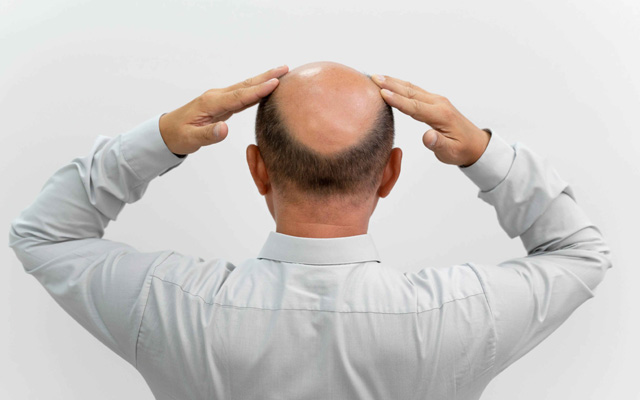
Is your hairline slowly receding?
Are you noticing thinning hair around the crown?
It may lead to male pattern baldness.
Most men notice male pattern baldness, also known as androgenetic alopecia. It affects millions of men, leading to a significant loss of self-esteem and confidence. This condition progresses gradually, but its impact can be profound. Several advanced treatments are available today that can halt or even reverse the process.
Let’s give a clear idea of what male pattern baldness is, how it’s diagnosed, and the advanced treatments that actually work.
What Is Male Pattern Baldness?
Male pattern baldness is the most common type of hair loss among men, and it typically follows a predictable pattern. It causes a receding hairline and thinning at the crown, eventually leading to baldness in severe cases.
What exactly causes male pattern baldness?
Male pattern baldness, scientifically known as androgenetic alopecia, is primarily due to genetic factors and the effects of Dihydrotestosterone (DHT). DHT is a hormone that binds to hair follicles, causing them to shrink over time. This shrinking process gradually reduces hair thickness until the follicles no longer produce hair.
Is it hereditary?
Yes, the condition is largely hereditary. If your father or grandfather experienced hair loss, you are more likely to experience it as well. Interestingly, the genes from both your mother’s and father’s side can influence the severity and age at which you start seeing symptoms.
Male pattern baldness follows a specific pattern, starting with a receding hairline and progressing with bald spots at the crown of the head. This process can take years, but early diagnosis and treatment can help slow or prevent further hair loss.
How does DHT contribute to hair loss?
Dihydrotestosterone (DHT) is the main hormone responsible for male pattern baldness. DHT is a derivative of testosterone, and while it’s responsible for male physical development, it also contributes to hair follicle shrinkage.
What does this mean for your hair?
Over time, DHT weakens hair follicles, causing them to produce thinner hair until they stop growing hair altogether.
What makes some men more likely to experience male pattern baldness?
The answer lies in your genetics, specifically the AR gene. The AR (Androgen Receptor) gene, located on your X chromosome, plays a crucial role in how your hair follicles respond to Dihydrotestosterone (DHT), the primary hormone responsible for hair loss in men.
So, how does the AR gene affect hair loss?
Men who inherit a sensitive AR gene are more likely to have hair follicles highly responsive to DHT, leading to hair thinning and accelerated hair loss.
How does this affect the degree of hair loss?
The sensitivity of your hair follicles to DHT determines how early hair loss begins and the rate at which it progresses. This means that if you have the gene, you’re likely to see signs of thinning hair or a receding hairline earlier than others.
How do you track the progression of male pattern baldness?
The Norwood Scale is used to stage male pattern baldness, providing a clear picture of the extent of the condition’s progression. Here’s a breakdown of the seven stages:
- Stage 1: Minimal to no hair loss, hairline remains intact.
- Stage 2: Slight recession at the temples.
- Stage 3: Noticeable hairline recession and thinning around the temples, forming an “M” or “U” shape.
- Stage 4: Deep recession of the hairline and thinning at the crown.
- Stage 5: Recession connects the temples with a noticeable bald spot.
- Stage 6: Extensive hair loss, with only a thin band of hair remaining.
- Stage 7: Severe hair loss, leaving only a narrow band of hair around the sides.
Understanding where you fall on the Norwood Scale can help guide your treatment options and give a clearer idea of what to expect with treatment.
How Male Pattern Baldness Is Diagnosed
Diagnosing male pattern baldness is usually straightforward for a skilled dermatologist or hair loss specialist. It involves a combination of physical exams, diagnostic tools, and sometimes blood tests to ensure an accurate diagnosis.
How is male pattern baldness diagnosed?
A scalp evaluation is typically the first step. The doctor will examine your scalp to assess areas where hair is thinning or receding.
What are they looking for?
The doctor will look for a receding hairline or thinning at the temples and crown. They will also check for signs of scalp conditions like dandruff or psoriasis that could be contributing to hair loss.
Is this method reliable?
Yes, a scalp evaluation is a standard and effective way to identify early-stage male pattern baldness and confirm if the hair loss is due to androgenetic alopecia.
Can technology assist in diagnosing hair loss?
Yes Trichoscopy is a method that uses a dermatoscope to magnify and examine the scalp, providing a clear view of the hair follicles and their health.
What can it reveal?
It helps doctors identify miniaturised hair follicles, which are a key indicator of male pattern baldness. This technology is non-invasive and offers more detailed analysis than a simple scalp evaluation.
How does digital hair analysis work?
Digital hair analysis uses high-definition imaging to provide a clearer picture of hair density and follicle health. It’s an effective tool for assessing hair growth and can be used to track treatment successover time.
For those seeking reliable solutions for hair restoration, consider consulting Elation Hair & Skin Clinic, the best hair transplant clinic in Kolkata, where advanced diagnostic technology plays an important role in achieving optimal results.
Blood Tests and Hormonal Assessment
Sometimes, blood tests are used to rule out other conditions that can contribute to hair thinning.
What conditions are tested for?
Hormonal imbalances such as hypothyroidism, vitamin D deficiency, or iron deficiency can all contribute to hair thinning, and blood tests help identify these factors.
How does this affect your treatment plan?
If the cause of hair loss is not male pattern baldness, addressing the underlying condition first can help restore hair growth.
Advanced Non-Surgical Treatments
For those who prefer non-invasive treatments, there are several options that can produce significant results without surgery.
PRP Therapy
- Platelet-Rich Plasma (PRP) therapy is a cutting-edge treatment that uses your own blood to rejuvenate hair follicles.
- A small amount of your blood is drawn, processed to concentrate the platelets, and then injected into your scalp.
- These platelets contain growth factors that stimulate hair growth and improve follicle health.
GFC Treatment
- Growth Factor Concentrate (GFC) is similar to PRP but involves a more concentrated mix of growth factors to promote faster hair regrowth.
- It’s a newer, more advanced non-surgical hair restoration method that delivers promising results for many men dealing with male pattern baldness.
Low-Level Laser Therapy (LLLT)
- LLLT uses laser light to stimulate hair follicles, improving hair density and promoting hair regrowth.
- It’s a non-invasive, FDA-approved treatment that can be done in the clinic or at home with a laser comb.
Surgical Treatments for Male Pattern Baldness
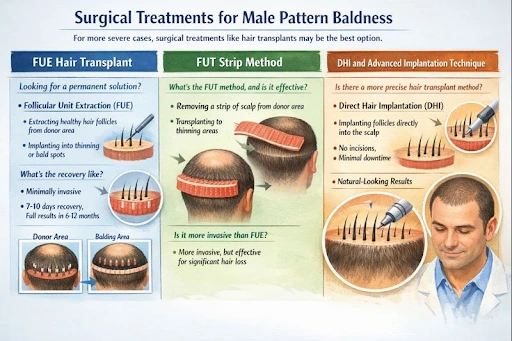
FUE Hair Transplant
Follicular Unit Extraction (FUE) is one of the most advanced hair transplant methods. It involves extracting healthy hair follicles from a donor area and implanting them into thinning or balding areas of the scalp.
What’s the recovery like?
The procedure is minimally invasive with a recovery time of 7-10 days. Results appear gradually, and full results can take up to 12 months.
FUT Strip Method
- The FUT Strip Method involves removing a strip of scalp from the donor area and transplanting it to the thinning areas.
- It’s ideal for patients with more significant hair loss.
Is it more invasive than FUE?
Yes, but it’s highly effective and offers natural-looking results.
DHI and Advanced Implantation Technique
Direct Hair Implantation (DHI) is a precise method that places hair follicles directly into the scalp without incisions. This technique ensures a natural-looking result with minimal downtime.
Fight Hair Loss: Top Treatments for Male Pattern Baldness
If you’re experiencing male pattern baldness, don’t lose hope; there are plenty of effective treatments available to help slow or stop hair loss. From medications like minoxidil and finasteride to advanced non-surgical treatments like PRP therapy and hair transplants, you have multiple options.
Ready to take control of your hair loss? Book a consultation today at Elation Hair & Skin Clinic, one of the best hair transplant clinics in Kolkata, for personalised advice and effective treatment.
People Also Ask (FAQs)
- What is the best hair transplant method for male pattern baldness?
The best hair transplant method depends on individual needs, but Follicular Unit Extraction (FUE) is often preferred for its minimally invasive nature and natural-looking results. - How long does it take to recover from a hair transplant?
Recovery typically takes 7-10 days for FUE hair transplants, with full results visible in 6-12 months, depending on the patient’s healing process. - Is the FUT hair transplant method more invasive than FUE?
Yes, the FUT method is more invasive because it involves removing a strip of scalp. However, it is effective for patients with significant hair loss. - How does DHI hair transplant work?
Direct Hair Implantation (DHI) involves implanting hair follicles directly into the scalp with minimal incisions, resulting in natural-looking results and minimal downtime.