
Watching your distinct curls thin out feels like losing a part of your personality
For curly or coarse hair, the stakes are higher; one wrong angle during extraction can kill the follicle’s unique “S” shape forever.
Precision isn’t just a preference; it’s a requirement to maintain that natural, dense look. One wrong angle and the graft is lost forever.
To ensure your natural density and curl pattern are preserved, you need the specialised expertise found at Elation Hair & Skin Clinic, the leading hair transplant clinic in Kolkata.
In this blog, you will discover why technique matters more than ever for textured hair. Curved follicles, unpredictable angles, and higher transection risks make expertise essential.
Understanding the Unique Anatomy of Curly and Coarse Hair
Curly and coarse hair appears simple on the surface, but beneath the scalp, it follows a curved, “C”- or “S”-shaped path. Unlike straight follicles that grow almost vertically, curly follicles bend and twist deep inside the skin.
The visible strand direction often doesn’t match the root’s underground angle. This hidden curve is exactly what makes extraction more technically demanding during a transplant.
How Curly Follicles Differ from Straight Hair
Straight hair grows almost vertically from the scalp. The follicle beneath the skin is relatively linear.
Curly hair is different. The follicle forms a “C” or “S” shape deep within the dermis. The visible strand may look simple, but beneath the surface, it bends dramatically before emerging from the scalp.
Anatomical differences:
- The bulb sits at a curved angle under the skin
- The shaft bends before exiting the scalp
- Root direction rarely matches visible hair direction
- The follicle is thicker yet more fragile during extraction
This explains why curved hair follicle extraction challenges are common when the technique is not adapted.
Why Curved Follicles Grow at Unpredictable Angles
The hair you see is not the full story. The underground portion may twist sharply, even if the strand appears straight at the surface.
Automated tools cannot “see” this underground curve. Only a trained surgeon can interpret subtle visual cues and adjust the punch angle in real time.
Is curly hair harder to transplant?
– Yes, if the surgeon treats it like straight hair.
– No, if the technique is customised.
Why Hair Texture Changes Hair Transplant Planning
Texture is not a cosmetic detail. It is a surgical strategy.
Hair texture influences every surgical decision:
- Graft extraction depth
- Punch diameter
- Angle of implantation
- Density distribution
- Donor area selection
Surgeons often harvest from the back of the scalp. In some cases, beard or body hair may be used to match thickness.
Impact of Curl Pattern on Graft Extraction
During extraction, the punch must follow the natural curve. A rigid, straight approach increases the risk of transection.
Transection Risk by Texture
| Hair Type | Transection Risk |
| Wavy | Moderate |
| Curly | High |
| Very Coarse/Afro-textured hair transplant results | Very High (if technique not modified) |
Proper coarse hair technique includes:
- Manual punch control
- Depth calibration
- Real-time angle correction
- Slow, deliberate extraction
Why Coarse Grafts Require Special Handling
Coarse follicles carry more tissue. That means they need more protection outside the body.
They require:
- Continuous hydration
- Controlled temperature
- Minimal handling
- Reduced out-of-body time
These steps directly influence hair graft survival in coarse hair and long-term density.
How Textured Hair Influences Final Density
It’s not about numbers. It’s about optical density.
Curly hair has a visual advantage. Because it bends and overlaps, it covers more surface area.
A well-planned curly hair transplant may require fewer grafts than a straight hair transplant to achieve similar visible fullness.
The Biggest Surgical Challenge: Follicle Transection
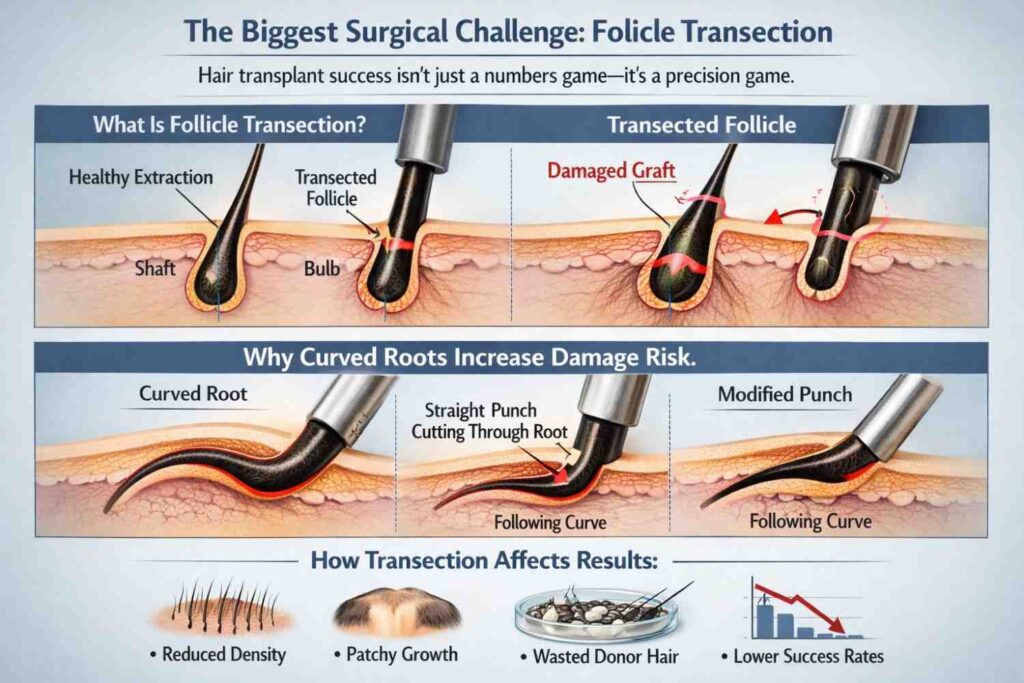
Hair transplant success isn’t just a numbers game—it’s a precision game. Even a slight error during extraction can permanently damage the follicle, affecting how well the graft grows later. That’s why managing follicle transection is one of the most crucial and skill-dependent aspects of the entire procedure.
What Is Follicle Transection?
Transection occurs when the surgical punch slices through the hair bulb or shaft. A damaged graft may never grow.
Why Curved Roots Increase Damage Risk
Since the root curves beneath the surface, a straight punch can cut across it. Without modification, transection rates rise significantly.
How Transection Affects Results
High transection leads to:
- Reduced density
- Patchy growth
- Wasted donor hair
- Lower transplant success rates
FUE vs FUT for Curly or Coarse Hair
Choosing between FUE and FUT depends on curl tightness and donor characteristics.
| Feature | FUE | FUT |
| Extraction | Individual punch removal | Strip of scalp removed |
| Graft Visibility | Blind extraction | Microscopic dissection |
| Transection Risk | Higher in tight curls | Lower under magnification |
| Scarring | Tiny dot scars | Linear scar |
| Recovery | 3–5 days | 10–14 days |
Let’s learn about it in detail:
Follicular Unit Extraction (FUE)
Advantages of Textured Hair
- No linear scar
- Suitable for short hairstyles
- Faster healing
Challenges in Curved Follicles
- Blind extraction
- Higher transection risk
- Requires extreme angle control
Importance of Customised Tools
Flared punches and oscillatory manual tools reduce graft damage. Standard punches are rarely enough.
Consult Elation Hair & Skin Clinic, a hair transplant clinic in Kolkata, for a personalised session.
Follicular Unit Transplantation (FUT)
When FUT May Be Better
In very tight curls, FUT often preserves graft integrity better because follicles are dissected under microscopes.
Strip Harvesting Advantages
- Full root visibility
- Better graft preservation
- Reduced accidental clipping
Scar Considerations
The linear scar is typically hidden beneath longer hair.
When comparing FUE vs FUT for curly hair, expertise matters more than the technique itself.
Hairline Design for Natural Curly Results
Curly hairlines must look organic. Straight lines appear artificial. Thicker grafts are placed slightly behind the front zone to create depth and shadow.
| Hairline Element | Straight Hair Approach | Curly Hair Approach |
| Front Row | Uniform | Irregular |
| Angle | Slight tilt | Spiral-based |
| Graft Type | Mixed | Single-hair soft zone |
| Density | Even | Layered |
| Flow | Linear | Natural curl direction |
Recovery and Growth Timeline
Curly grafts may initially appear thinner. Texture takes time to regain shape.
Typical Timeline
- 1–2 weeks: Shedding phase
- 3–4 months: Early regrowth
- 6–9 months: Visible density
- 12–15 months: Full curl bounce restored
Curly hair is more prone to ingrown strands. Gentle washing, avoiding tight caps, and scheduled follow-ups prevent complications.
Common Mistakes in Curly Hair Transplants
- Using the straight-hair extraction technique
- Incorrect implantation angles
- Poor hydration
- Technician-only extraction without surgeon control
These errors reduce graft survival and compromise long-term results.
Technique Determines Everything
Curly and coarse hair transplantation requires an understanding of anatomy, micro-level precision, and real-time surgical judgment.
When done correctly, textured hair transplants deliver:
- High graft survival
- Natural hairline design
- Dense, believable coverage
- Long-term permanence
At Elation Hair and Skin Clinic, a trusted hair transplant clinic in Kolkata, every graft is extracted and implanted with customised control designed specifically for textured hair.
Contact with our experts and begin your journey toward fuller, natural-looking curls. Call +91 98300 85599 today.
People Also Ask
- Is curly hair harder to transplant?
Yes, because the follicles curve beneath the skin, making extraction more complex. The surgeon must carefully adjust the punch angle and depth. With proper technique and experience, excellent results are absolutely achievable.
- Which technique gives the best density?
Both FUE and FUT can deliver strong density when customised for textured hair. The choice depends on curl tightness, donor quality, and scalp condition. Expertise matters more than the method itself.
- Does textured hair increase complication risk?
Not inherently. Complications rise only when straight-hair techniques are used on curved follicles. When handled with specialised tools and surgical precision, outcomes are safe and predictable.
- Are the results permanent?
Yes. Transplanted hair is taken from genetically resistant donor areas, usually the back of the scalp. Once it grows, it continues to behave like normal, permanent hair.
- How many grafts are needed?
Curly hair often requires fewer grafts compared to straight hair. Its natural bend creates better visual coverage, allowing surgeons to achieve fullness with strategic placement rather than higher numbers.