
You’ve tried everything from hair growth products to styling tricks, but nothing seems to work.
As the frustration of hair loss intensifies, you start searching for a permanent solution. During your research, you discover hair transplant surgery, which is a proven, effective way to restore not just your hair but your confidence as well.
At Elation Hair and Skin Clinic, we understand your concern and are here to provide answers.
Let’s take a deep dive into the risks, recovery, and reality check of hair transplants to help you make an informed decision. Before that, let’s give you a brief idea of what a hair transplant is and why it is done.
What is a Hair Transplant and How Does It Work?
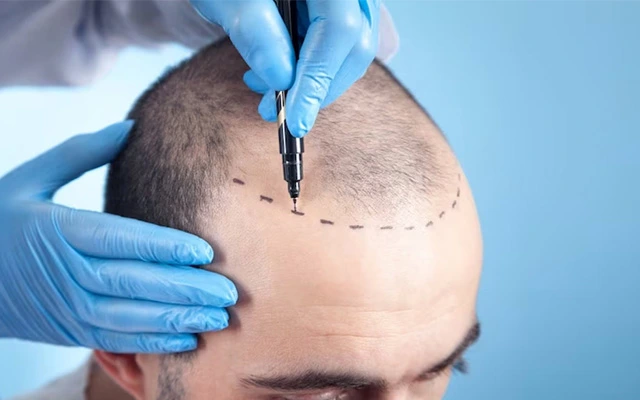
Hair transplant surgery is a life-changing procedure for those struggling with hair loss. It involves relocating healthy hair follicles from a donor area (typically the back or sides of your scalp) to thinning or bald areas.
But how exactly does it work, and what makes it the go-to solution for permanent hair restoration?
Types of Hair Transplants: Which One is Right for You?
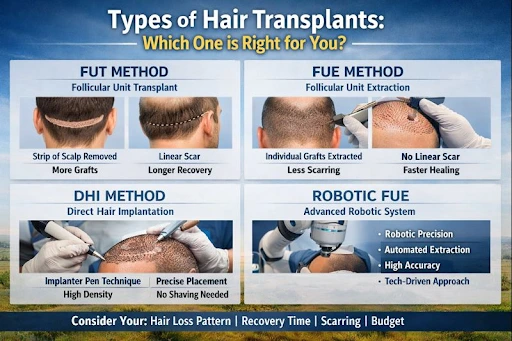
There are two primary techniques used in hair transplant surgery: FUE (Follicular Unit Extraction) and FUT (Follicular Unit Transplantation).
Let’s explore each technique to help you understand which one could work best for your needs.
FUE (Follicular Unit Extraction) – Minimally Invasive and Fast Recovery
What is FUE?
In this method, individual hair follicles are carefully extracted from the donor area and transplanted into the bald or thinning areas.
Why Choose FUE?
This technique is minimally invasive, involves no cutting or stitching, and leaves no visible linear scar. With FUE, you can enjoy a quick recovery—patients often resume normal activities within a few days.
FUT (Follicular Unit Transplantation) – Larger Graft, Great for More Coverage
What is FUT?
In FUT, a small strip of skin is removed from the back of your head, and the hair follicles are extracted from that strip and placed into the recipient area.
Why Choose FUT?
This method is typically preferred for patients who require a large number of grafts and have a more significant area of hair loss. However, it may leave a small linear scar.
Myths VS Facts - What Worries Patients Most?
When patients think of hair transplant surgery, they often picture long recovery times, pain, and potentially unnatural results. However, these concerns are largely rooted in outdated perceptions.
| Concern | Fact | Myth |
| Recovery Time | With FUE, the procedure is less invasive, has minimal downtime, and offers natural-looking results. Most patients feel minimal discomfort, and the healing process is quick. | Patients fear long recovery times, but with FUE, recovery is faster, and you can resume activities in 3-4 days. |
| Pain | Most patients experience minimal pain, and any discomfort is managed with local anaesthesia and mild pain relievers. | Some worry that hair transplant surgery is extremely painful, but the procedure is largely pain-free. |
| Scarring | Modern methods, especially FUE, ensure minimal scarring. Since no large incisions are made, the risk of visible scarring is significantly reduced. | There is a misconception that hair transplants cause permanent, noticeable scarring, but with FUE, scarring is minimal and barely noticeable. |
Understanding the Risks—What Could Actually Go Wrong?
Despite its high success rate, hair transplant surgery does carry some risks. But understanding these risks will help you feel more confident in making the right decision.
Here is the list of the risk factors:
Infection, Swelling, and Redness: Are They Common?
We often overlook this factor as natural. However, it can lead to serious consequences. It’s normal to experience mild swelling, redness, or itching at the transplant site, especially in the first few days following surgery. These side effects are temporary and can be easily managed with proper care.
Shock Loss: What It Is and Why It’s Temporary
Have you heard about this before?
One of the more surprising aspects of hair transplant recovery is shock loss, where newly transplanted hair falls out temporarily after the procedure. This can be alarming, but rest assured that it is a natural part of the recovery process. In fact, your new hair follicles will begin growing again within a few months.
Poor Growth Due to Technique: Is It the Surgery’s Fault?
Went through the surgery, but my new hair is not growing as expected. Did I make the wrong choice?
This is a concern that sometimes arises after hair transplant surgery, especially when patients don’t see the full results they were hoping for. If you’re wondering why your new hair might not be growing as expected, it’s important to understand that poor growth is often a result of factors that have nothing to do with the surgery itself but everything to do with technique and post-op care.
Hair Transplant Recovery—What Does It Really Look Like?
Let’s take a closer look at hair transplant recovery. Knowing what to expect at each stage will help ease your anxiety and make the process smoother.
- First 7 Days: Scabs, Redness, and Care
In the first week after your hair transplant, you’ll likely notice some redness and small scabs around the transplanted follicles. This is completely normal and part of the healing process. It’s crucial to follow your post-operative care instructions carefully to avoid complications like scalp infection.
- Weeks 2–6: The Shedding Phase
It’s common for transplanted hair to shed within the first few weeks. This shedding phase is temporary. In fact, it’s a sign that the transplanted follicles are settling into their new home and will start growing back stronger in the coming months.
- 3–6 Months: New Growth Begins
Around the 3 to 6-month mark, you’ll begin to see new hair growth in the transplanted areas. While this new hair may initially appear thin, it will gradually thicken over time. It is important to be patient during this phase, as your hair is still adjusting to the transplantation process.
- 9–12 Months: Final Results Settle
By 9 to 12 months, you’ll start seeing the final results of your hair transplant. At this point, the hair will have thickened, and you’ll have a natural, fuller head of hair. It’s important to remember that full results may take up to a year to appear.
For more information on how the process works, you may contact Elation Hair & Skin Clinic, a hair transplant clinic in Kolkata, where expertise and patient care go hand in hand.
Does Hair Transplant Surgery Affect Overall Health?
You might be concerned about whether hair transplant surgery could affect your health. Let’s clear up some common misconceptions.
Anaesthesia Safety: Local, Not General
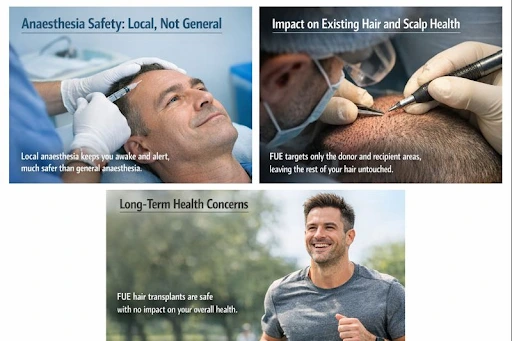
For hair transplant surgery, only local anaesthesia is used, which means you’ll remain awake and aware throughout the procedure. Local anaesthesia is much safer than general anaesthesia, which carries more risks. You won’t experience any major side effects from anaesthesia.
Impact on Existing Hair and Scalp Health
The FUE technique ensures minimal disruption to your existing hair follicles. The transplant only affects the donor and recipient sites, leaving the rest of your scalp and hair unaffected.
Long-Term Health Concerns
There’s a myth that hair transplant surgery can cause long-term health problems. In reality, FUE hair transplant safety ensures no adverse effects on overall health. It’s a safe, effective procedure when performed by experienced surgeons.
Your Journey to Natural, Thicker Hair Begins Now
In hair restoration, hair transplant surgery is a proven, safe, and effective solution when performed with care, skill, and precision. While concerns about safety, risks, and recovery are valid, they can be addressed by choosing the right clinic and following the correct procedures.
Let us help you achieve the fuller, thicker hair you’ve always wanted. Book your consultation at Elation Hair and Skin Clinic, a hair transplant clinic in Kolkata, and get personalized advice personalised to your needs.
Contact at +91 98300 85599 today.
People Also ask (FAQs)
- Is hair transplant surgery safe or risky?
While no surgery is without risk, hair transplant surgery is considered safe, especially with modern FUE techniques. The risks are minimal and manageable.
- Are hair transplants permanent and safe?
Yes, hair transplants are permanent and safe when performed by a qualified surgeon. The results are long-lasting, with proper care and maintenance.
- What is the success rate of hair transplant surgery?
The success rate of hair transplant surgery is very high, especially with FUE. Most patients experience significant improvement in hair growth and density.
- How long does it take to recover from a hair transplant?
Recovery time is relatively short, with most patients resuming normal activities within 3–4 days. Full results may take up to 12 months to be visible.